How to read a polar scope reticle
The celestial pole is not exactly where Polaris is. In 2026 Polaris sits about 37 arcminutes from the north celestial pole and circles it once a sidereal day (23 h 56 min). A polar scope reticle has a circle of that radius around its centre. Your job is to put Polaris on that circle at the right angle for this moment. Then the centre of the reticle, and your mount's RA axis, point at the pole.
The clock position
Most apps, ours included, give that angle as a clock reading: "Polaris at 7:07" means you read the circle as a clock face with 12 at the top and put Polaris where the hour hand would point at 7:07. The angle depends only on your longitude and the time, so it changes by a full turn every sidereal day.
A polar scope shows the sky turned 180°, like most small refracting finders. A good app draws the reticle the way you see it through the scope, so you copy the picture rather than flip it in your head. If your scope adds a mirror or a diagonal, the image is also mirrored left to right.
Step by step
- Level the mount and set the latitude scale roughly to your latitude.
- Point the RA axis roughly north (south in the southern hemisphere) and find Polaris in the polar scope.
- Rotate the RA axis, or the reticle on trackers that allow it, until the 12 o'clock mark is at the top as you look through the scope.
- Read the clock position from the app and move the mount with its altitude and azimuth bolts, not the RA or Dec axes, until Polaris sits on the circle at that position.
- Lock the bolts, then check again a minute later. The star moves slowly, so the reading barely changes over a few minutes.
Sky-Watcher plate (EQ6-R, Star Adventurer 2i)
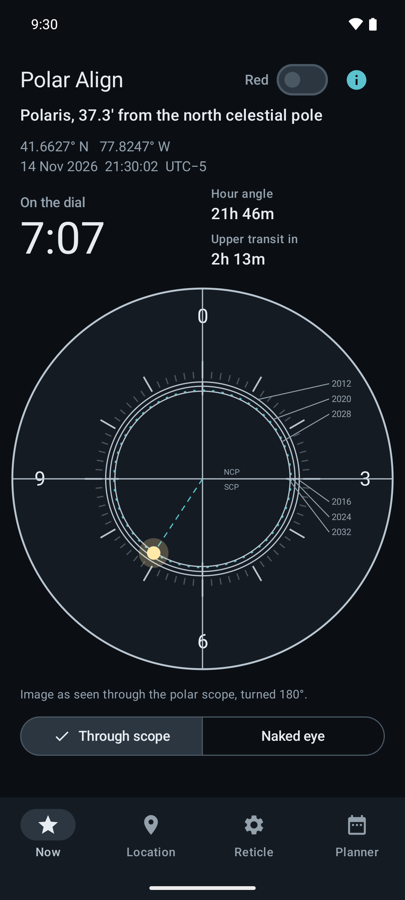
The plate has a full cross hair with 0 at the top, then 3, 6 and 9. Around the centre are three circles for the position of Polaris in 2012, 2020 and 2028, with small markers at 0, 3, 6 and 9 o'clock for 2016, 2024 and 2032. Precession slowly moves Polaris closer to the pole, so in 2026 use a radius between the 2020 and 2028 circles, closer to 2028.
iOptron plate (SkyGuider Pro)
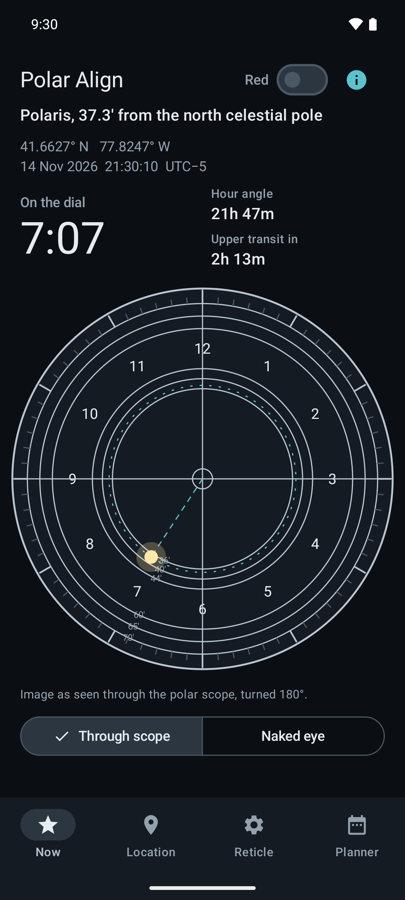
The dial runs from 1 to 12 with a tick every 10 minutes. The inner circles at 36, 40 and 44 arcminutes are for Polaris; the outer ones at 60, 65 and 70 arcminutes are for sigma Octantis in the southern hemisphere.
Southern hemisphere
There is no bright pole star in the south. Sigma Octantis is about 69 arcminutes from the south celestial pole and is faint (around magnitude 5.4), so a dark site and a polar scope with a southern pattern help. Plates that only carry Polaris circles, like the Sky-Watcher one above, cannot be used for the south by clock position alone.
An app that does the reading
Polar Align draws these plates with the star at the right spot for your site and time, works offline, and has a red night mode. It is an Android app from Notchwork.